主要统计指标解释
[能源生产总量]指一定时期内,全国一次能源生产量的总和。该指标是观察全国能源生产水平、规模、构成和发展速度的总量指标。包括:原煤、原油、天然气、水电、核能及其他动力能(如风能、地热能等)发电量等,不包括低热值燃料生产量和由一次能源加工转换而成的二次能源产量。
[能源消费总量]指一定地域内,国民经济各行业和居民家庭在一定时期内消费的各种能源的总和。包括:原煤、原油、天然气、水能、核能、风能、太阳能、地热能、生物质能等一次能源;一次能源通过加工转换产生的洗煤、焦炭、煤气、电力、热力、成品油等二次能源和同时产生的其他产品;其他化石能源、可再生能源和新能源。其中水能、风能、太阳能、地热能、生物质能等可再生能源,是指人们通过一定技术手段获得的,并作为商品能源使用的部分。在核算过程中,一次能源、二次能源消费不能重复计算。能源消费总量分为终端能源消费量、能源加工转换损失量和能源损失量三部分。
[能源生产弹性系数]是研究能源生产增长速度与国民经济增长速度之间关系的指标。计算公式为:

国民经济年平均增长速度,可根据不同的目的或需要,用国民生产总值、国内生产总值等指标来计算。
[电力生产弹性系数]是研究电力生产增长速度与国民经济增长速度之间关系的指标。计算公式为:

[能源消费弹性系数]反映能源消费增长速度与国民经济增长速度之间关系的指标。计算公式为:

[电力消费弹性系数]反映电力消费增长速度与国民经济增长速度之间关系的指标。计算公式为:

[能源加工转换效率]指一定时期内,能源经过加工、转换后,产出的各种能源产品的数量与同期内投入加工转换的各种能源数量的比率。该指标是观察能源加工转换装置和生产工艺先进与落后、管理水平高低等的重要指标。计算公式为:

[单位国内生产总值能耗]指一定时期内,一个国家或地区每生产一个单位的国内生产总值所消费的能源。计算公式为:

[单位国内生产总值电耗]指一定时期内,一个国家或地区每生产一个单位的国内生产总值所消费的电力。计算公式为:

Explanatory Notes on Main Statistical Indicators
Total Primary Energy Production refers to the total production of primary energy in a given period of time. It is a comprehensive indicator to show the level, scale, composition and growth of energy production of the country. It includes that of coal, crude oil, natural gas, hydropower and electricity generated by nuclear energy and other means such as wind power and geothermal power, etc. However, it does not include the production of fuels of low calorific value and secondary energy converted from primary energy.
Total Energy Consumption refers to the total consumption of energy of various kinds by the production sectors of the economy and the households in a given period of time. It includes primary energy such as coal, crude oil, natural gas, hydropower, nuclear power, wind power, solar power, geothermal power and bio-energy; the secondary energy and their products which are transformed from the primary energy such as washed coal, coke, coal gas, electricity, heating, and petroleum products; and other kinds of fossil energy, renewable energy and new energy. The renewable energy refers to the part of renewable energy that is attained with some given technical means and used for commercial purposes, including hydropower, wind power, solar power, geothermal power and bio-energy. In the process of accounting, there should be no double or multiple counting between and primary and the secondary accounting. Total energy consumption can be divided into three parts: final energy consumption; loss during the process of energy transformation; and other losses.
Elasticity Ratio of Energy Production is an indicator to show the relationship between the growth rate of energy production and the growth rate of the national economy. The formula is:
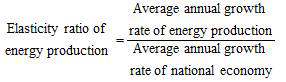
The average annual growth rate of the national economy can be measured by indicators such as the gross national product or the gross domestic product, depending on the purposes or needs.
Elasticity Ratio of Electricity Production is an indicator to show the relationship between the growth rate of electricity production and the growth rate of the national economy. The formula is:
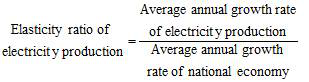
Elasticity Ratio of Energy Consumption is an indicator to show the relationship between the growth rate of energy consumption and the growth rate of the national economy. The formula is:
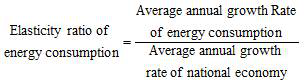
Elasticity Ratio of Electricity Consumption is an indicator to show the relationship between the growth rate of electricity consumption and the growth rate of the national economy. The formula is:
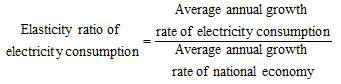
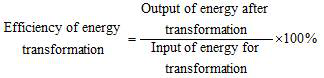
Efficiency of Energy Transformation refers to the ratio of the total output of various kinds of energy products after transformation to the total input of various kinds of energy for transformation during a given period. It is an important indicator to show the current conditions of energy transformation equipment, production technique and management. The formula is:
Energy Consumption per Unit of GDP refers to the energy consumption per unit of gross domestic product in a country or in a region during a given period. The formula is:

Electricity Consumption per Unit of GDP refers to the electricity consumption per unit of Gross Domestic Product in a country or in a region during a given period. The formula is:
